
The New Year has come and gone, and I’ve still got the Tandem t:slim X2 plugged in to my body. Today’s post is all about Tandem in sport. How does it fare?
Within days of starting my Tandem Trials, I was ready to give this sucker the ultimate challenge: a ride on my bike.
Now, because I am very much a fair weather cyclist, we did not go for a ride outside. Instead, we did an intense 60-minute Peloton bike ride.
And we’ve continued to do many more Pelotons, as well as walks and weights.
Here are my Peloton-Tandem reflections.
Tandem in sport strategy
My rides typically occur in the morning, after breakfast, or in the afternoon, after work. Both options require different strategies.
The breakfast strategy:
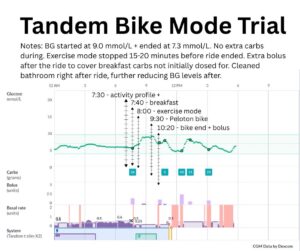
With the help of my super supportive Tandem ally, I created a sport-specific profile to use when I’m planning a ride around the breakfast hour. I do not skip breakfast; this is not an option for me.
For this profile, we reduced the basal, increased the correction factor, and increased the carb ratio. The basal rate was reduced by about 70% and the others increased by about 50-60%. This profile was created based on my past histories and strategies of previous runs and bike rides around the same time with the old-school insulin pumps.
The plan: start the exercise profile prior to dosing my insulin; wait 30-60 minutes before activating exercise, and let the profile run throughout. If needed, I could also implement the Tandem “activity mode” to target blood sugars between 7.8-8.9 mmol/L.
The afternoon strategy:
This one is a lot easier.
My afternoon rides are typically about 4-5 hours after lunch, which means relatively low insulin on board as long as the automated insulin delivery doesn’t kick in.
For this strategy, all I do is turn on activity mode (no extra profile needed) about 60-90 minutes before the ride, depending on blood sugars at the time.
Trial and error still needed
Although there have been a few hiccups, overall the results have been pretty great.
I’ve not had one low on any of the rides, and no concerning “blood sugars dropping fast” CGM alerts.
It did take a bit of getting used to NOT having to eat something before my afternoon rides. Previously, I almost always had to eat about 10-15 grams of carbs prior to getting on the bike. My first time getting on with Tandem, my blood sugars were 6.8 mmol/L; I had half an apple, and by the end of the ride, my blood sugars were rising up like I did not want them to be.
Lesson learned.
For the breakfast strategy, I’ve tried a few alterations:
- Activating both the sport profile and exercise mode at the same time
- Activating the sport profile, and delaying exercise mode until about 30 minutes prior to starting exercise
- Activating exercise mode about 90 minutes prior to starting exercise, and forgoing the sport profile completely
I’ve had decent results throughout with all options. My preferred currently is the exercise mode only option, but that one requires a bit more waiting around time, which I don’t always have.
With these strategies, for my longer rides, I can typically get about 45-50 minutes in without having to eat something. That’s fantastic! If we think about typical “fuelling” recommendations for sport, 45 minutes is an appropriate duration for energy input intervals.
Micromanagement still required
Both strategies, however, still do require some micromanaging, especially post exercise – when the blood sugars start to surge.
For both options, I turn off the sport profile (if on) and the exercise mode 15-20 minutes before stopping the ride. This allows the insulin and automated system to start working more efficiently while the muscles are still up taking energy.
I also plug in “ghost carbs” following the exercise to accommodate for any reduced bolus I may have given with the sport profile. Or, if no reduced bolus was given, I will still input a small correction post exercise to accommodate for the reduced basal during exercise – for me, I usually do a correction equal to how much insulin was reduced.
This is a strategy that I’ve found works for me through my own trial and error efforts. Keep in mind, all bodies are different, and your body may require a different strategy.

Tandem in sport conclusion
I am no longer worrying about lows during my workouts, and no longer having to stop and delay my workouts either.
That’s pretty freaking awesome!
I’m also not overly fretting about highs during my rides. I have seen my blood sugars go slightly higher than I like them once or twice during a ride, but turning off activity mode when still on the bike works pretty fast to turn those blood sugars around.
I’m loving that!
These are indoor rides only; I recognize that the metrics will likely change once I get the bike outside. And the post exercise blood sugars are still a work in progress. But, honestly, the trial and error efforts are mostly going in the right direction. I’m gonna get there; I know it.
So far so great with my Tandem in sport trials. I’m looking forward to seeing how it fares in the outside world, on my road bike, with longer durations.
Stay tuned …