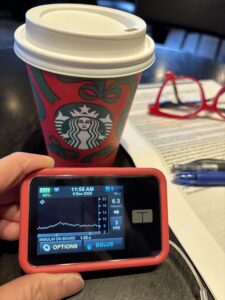
Welcome to part 2 of my Tandem t:slim X2 trial experience.
Although the Tandem t:slim X2 automated insulin delivery (AID) pump showed great strengths right away, there were still some struggles.
Honestly, the struggles were a bit hard for me to accept at first. After reading the research and going to the American Diabetes Association Conference last spring, and hearing all the positives about these AID systems, no matter how dubious I was going in, I really wanted this pump to be the “magic” tool to reduce all diabetes burnout and micromanaging.
Based on my experience over the last couple of months, though, it’s not the be all end all magic device – yet.
Am I surprised? No.
We have to recognize that insulin pumps, including the AID ones, are not pancreases. They have incredible features that keep getting better and better, but they’re still a hybrid, and hybrids don’t have the full functionality that the actual organ does.
The little things
Oh Tandem, you are a lovely little device. Super cute on the appearances, but as my mama always said, the pretty ones always have a flaw or two. Tandems little flaws include:
So much waste!
Oh my goodness. My garbage container now fills up three times as fast as it did prior to Tandem. Look at this packaging waste. Tandem – you can do better!

The smells!
Since switching from Omnipod to Tandem, my site changes now involve extra steps. The removal of the air bubbles from the syringe isn’t a new step, but there’s something about the Tandem syringe that most often results in me getting drops of insulin on my hands, clothes, chair, pretty much everywhere. And if you’ve ever smelled insulin, it stinks. So bad, that even my teenage boy comments on it!
The tube!
Having a tubed pump was probably my biggest concern going from Omnipod to Tandem. But honestly, it’s been more of a sometimes irritation than an issue. Like for instance,
- When driving: I started with having the pump attached to my waistband, but that was always uncomfortable in the car. I then transitioned it to my back pocket, but got worried that the insulin would get too heated with my heated seats, and am often trying to pull it out and onto my lap mid drive – all while paying attention to the road too.
- When sleeping: the pump and Dexcom sensor have to be able to interact for Control IQ to work, but the pump cannot communicate with the Dexcom through the body. So, I have to make sure that the front face of the pump is near the sensor. I often wear the sensor on my lower back, which means I aim to keep the pump directly behind. And because I toss and turn when sleeping, that pump sometimes falls off the bed, or sometimes I’ve found myself sleeping directly on top of it – both interrupting my quality of sleep

The big things
Once I started my Tandem trial, I noticed an increase in my blood sugars about two to three hours after most meals. These were not significant increases, but for me they were increases enough to cause concern.
This post-meal rise mostly occurred on the days that I work from home, when I’m less active during the work hours.
Friends, even with AID, activity still makes a difference!
On these days, my blood sugars after breakfast and lunch hovered in the 7-8.0 range, rather than the 5-6 range that I preferred. Post lunch I was okay with these numbers, as I am usually quite active once my day ends around 4 pm. However, about three hours after dinner, the sugars would start to rise again. They’d be stable for the first two hours after the meal, but just as I’d get hungry for a snack, they’d start the upward trend.
My meals generally are not high fat-high protein meals, so that was likely not the cause. Rather, I suspect that the algorithm, which is set to keep the blood sugars in a range between 6.25 to 8.9 mmol/L, was happy when I was in that range, no matter if I was on the high or low end of that range.
Although this is a big thing for me, in the grand scheme, it’s not a huge thing. It’s solvable with a little more micro managing.
I’ve played around with my settings quite a bit – first lowering the correction factor, then implementing 24-hour sleep mode, then adjusting my basal rates. Mostly, I’ve got the numbers down, preferring non-sleep mode over sleep mode, but it does still require some micro-managing on my end.
Tandem Trial conclusion part 2:
It’s still a work in progress, which is kinda the whole managing T1D mantra isn’t it 😉
Next up: let’s see how this sucker works with physical activity! Stay tuned…