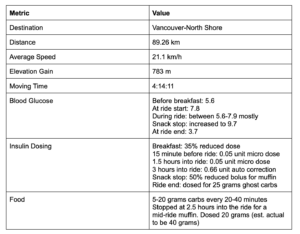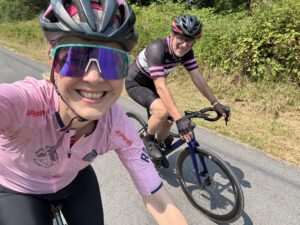
Today’s bike ride was just shy of 90 km, and was all about them hills.
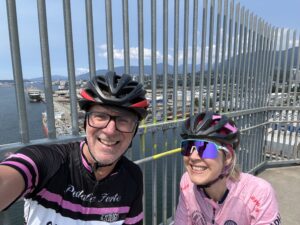
I swear my husband took us to all the hills he could find in the Vancouver area. First there was Camosun at UBC, then the Stan at Stanley Park, followed by the seemingly never-ending climb of the Second Narrows Bridge outside of the North Shore, and finally up Buckingham – Burnaby’s grind!
Unlike last week, my blood sugars were way more sensitive today, requiring a whole lot more food intake to keep them afloat.
That got me thinking about fueling for long-distance rides – specifically, what actually makes an “optimal” fuel source when you have type-1 diabetes.
Fueling Cycling with Type-1 Diabetes Isn’t One Size Fits All
I have been engaging in long distance cardio type sports for more than 15 years now. I started out as a runner, but over the years have since transitioned to cycling and hiking.
Over the years, I feel like I’ve tried just about every fueling option out there.
When I first started running, I bought into the hype of gels and sport specific energy chews. The gels were disgusting – like a lump of slime slithering down the throat. But, I thought then that I needed the gels and chews to be the best runner I could be.
The marketing was strong, my friends. And my wallet quickly emptied as a result!
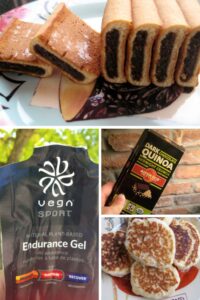
After about a year, I started experimenting beyond the commercialized fuel sources. Some of my concoctions included:
Homemade:
- Mini pancakes with a smidge of maple syrup
- Energy drinks that had 100% juice diluted with water + salt
- Power cookies (with chocolate!)
- Sweet rice cakes
- PB and honey sandwich
Commercial:
- Fig Newtons
- Swedish berries
- Applesauce pouches
- Dried apricots
- Pretzels
I even had a few friends over the years also suggest carrying salted potatoes and orange slices to sip the juice from. I didn’t try those ones, but was mildly intrigued.
The Best Fuel is the One That Works for You
A few paragraphs back, I wrote something along the lines of this post guiding you to the most “optimal” fuel sources for long-distance cardio with T1D. The reason I put quote marks next to optimal is because, honestly, there isn’t one specific food source that’s better than another.
It comes down to preference, and what works best for you specifically.
In theory, commercial gels and chews are designed to provide a convenient source of carbs during endurance exercise. But diabetes adds another layer to the equation. For me, they tasted awful and consistently upset my stomach.
And that’s definitely going to play a role in challenging performance outcomes. I had to pivot. I wanted to pivot.
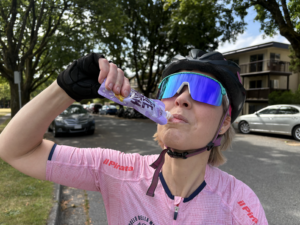
My current go-to food sources for the bike are gummy candies, cut up Rx Bars, and I recently brought back my beloved applesauce pouches.
These foods work for me both in terms of performance and blood sugars. And they don’t kill my guts either.
Fueling Performance and Blood Sugars
With regards to sport, here’s what we know:
During prolonged or higher-intensity exercise, we need a steady supply of easily digested carbohydrates to replace the glucose our muscles are using. Plus, foods that can raise blood sugars fairly quickly can also help with blood management during exercise.
Carbs break down into glucose. During intense and prolonged physical activity, our muscles are burning glucose like no one’s business. We need glucose to continue fuelling the muscles and optimize performance.
Furthermore, as our exercising muscles pull glucose from the bloodstream, blood sugars can fall fast – especially when insulin is active.
There are a lot of general recommendations out there for carb intake in the context of type-1 diabetes and sport, which I’m not going to dive deep into today. The thing to remember is that while these general recommendations can be a good starting point, we need to learn and acknowledge the specifics of our own body’s needs, and build the foundation from there. Because no body is the same, and no body with T1D is the same, responses to exercise may also not be the same.
All About Them Hills
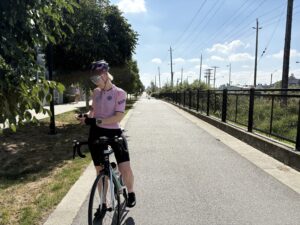
Okay, so back to those hills of today.
I felt pretty solid going up all of them. My legs were definitely screaming at points, and I could feel the lactic acid build up, especially after the 7 km hike I did with my son yesterday, but they weren’t fighting the ride.
And that’s exactly why finding the “optimal” fuel isn’t about buying the most expensive gel on the shelf. It’s about finding the foods that keep your body moving, your stomach happy, and your blood sugars working with you (relatively 😉 ) instead of against you.
Today’s Ride Stats: