I’m about to go for a long bike ride, and my blood sugars are 7.9 mmol/L. Do I:
- A) eat a small amount of carbs before going?
- B) eat a larger amount of carbs with protein and fibres?
- C) eat nothing at all and hope for the best?
The cookie cutter recommendations, tell me either option A or option C.
Yet, I chose option B.
That’s because I know my body, I know how much insulin I have circulating, and I know how my body reacts to endurance cardio.
Veering from the cookie cutter
Hi friends,
Happy Canadian Thanksgiving!!
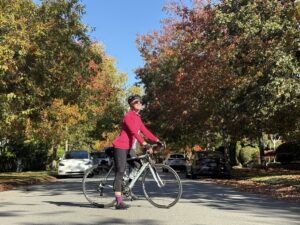
This weekend my husband and I were kid free. The boy went on his annual Thanksgiving camping trip with his auntie, uncle and cousins. And the husband and I decided to show our thanks with a “Le Tour de Autumn” bike ride through the colourful streets of Vancouver, Burnaby and New Westminster.
I love this time of year – the crispness of the air, the leaves, so many beautiful colours, and the angle of the sun that just makes everything pop.
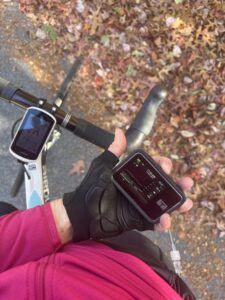
My blood sugars were 7.9 mmol/L just before starting. I’d had activity mode activated for about an hour already. Plus, I had just switched my basal profile to the exercise profile, which has less aggressive basal and correction settings. My last meal-time insulin was about 2.5 hours earlier, and was a reduced dose.
The general recommendations for managing endurance cardio with an automated insulin delivery system, like my trusty Tandem, states that based on those blood sugars, I probably didn’t need to snack at that point. And if I did need a snack, those recommendations focused more on 3-10 grams of carbs.
Not 25 grams like I took in!

RXBARs and micro-dosing for the win
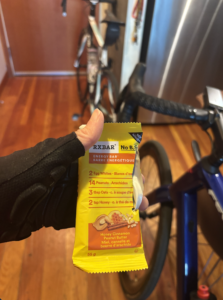
I mowed down on an RXBAR right before heading out. These suckers have 25 grams of net carbs, 4 grams of fibre, 11 grams of protein.
Why did I choose that strategy over the general recommendations?
Because I know my body. I know that if I didn’t eat something, my blood sugars would drop so freaking fast the moment I started peddling.
Through trial and error, I have discovered that these bars work the best for me when my blood sugars before a ride are between 5.0-9.0 mmol/L.
Eating them allows me at least 45 minutes of riding free – no worries of blood sugar drama.
I’m confident that I’m not going to go low. And because I also micro dose 0.05 units right at the start of my ride, I know that I won’t get any kind of premature correction if they start rising a bit too fast.
This works for me.
Foundation, not prescription
This is a strategy that veers from the cookie cutter strategies – and that’s okay.
I am not a cookie cutter person, and neither are you. None of us with T1D are.
That’s why I encourage all my peeps with T1D to use the general recommendations as a starting point, not a prescription. By making our sport strategies more specific to our individual needs, it’s going to help us optimize our T1D and sporting outcomes so much more successfully.
For me, my RXBAR, beginning of the ride strategy helps remove some of the stresses that Dear Diabetes presents.
When I’m on my bike, the last thing I want to be thinking about is the burden of T1D. I’d much rather be smiling up at the beautiful leaves 🙂